Friday, October 7, 2011

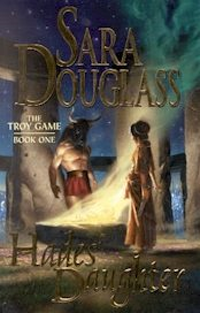
Review: Hades' Daughter by Sara Douglass


After the pregnant Ariadne is spurned by Theseus in favor of her younger sister she sets about enacting her revenge. She strikes a deal with the shade of her murdered half-brother the minotaur Asterion and with their combined power they destroy the games, magical protection wards, of the Greek cities plunging the Mediterranean world into a downward spiral. Asterion is free to reincarnate himself as a result, however Ariadne left the game intact in one minor Greek city intending her descendents to recreate the game, betray Asterion and sieze power. Now hundreds of years later Ariadne's descendent Genvissa puts this plan into action. She appears to Brutus, heir to the Troy game, as Artemis and promises him power and the rebuilding of a new and better Troy in Llangarlia (in Britain). As part of her plan Genvissa sends Brutus to Mesopotama, the only city with an intact game, to test him. However Genvissa did not foresee Brutus taking the princess Cornelia forcefully as his wife and while Genvissa believes Asterion is netralized he may be able to make use of Cornelia for his own purposes.

The historic aspects of this novel are very well researched. The story itself has definte echoes of the style of a Greek tradegdy and works all the better for it. I found the concept of all of the disaters that occured in the hellenic world in this period being part of Ariadne's revenge a particularly interesring twist.

Douglas presents the characters in an interesting light casting none of them as heroes or villians of the piece, all having a somewhat reasonable agenda. Brutus and Cornelia and their dysfunctional relationship take centre stage and while both of them do rather despicable things Douglass does an excellent job of keeping sympathy for them. Cornelia's character develops very well throughout the novel and the descision to have some chapters told from her first person perspctive was a shrewd one.

Overall Douglass produces an interesting tale that will appeal to both fans of fantasy and historic fiction. 8.5/10.

Friday, September 23, 2011

Review: Warriors edited by George R.R. Martin and Gardner Dozois


In the opening Martin states that this is a collection of stories about warriors that rather than be defined by a specific genre are an eclectic mix. That is certainly the case with every from Fantasy, Historical fiction, science fiction and contemporary fiction represented. The editors' goal were to simply have a collection of well written stories and in that they have succeeded.

The King of Norway by Cecelia Holland. Historic fiction piece on Vikings going raiding. Holland utilizes an authentic and appropriate 'voice' for this piece and creates an impressive atmosphere. 7/10.

Forever Bound by Joe Haldeman: Science fiction piece that recounts the tale of a group of young people drafted into the army and surgically linked together to operate war machines. Emotionally satisfying but the lack of action prevents it moving from very good to great. 7.25/10.

The Triumph by Robin Hobb: Historic fiction with a touch of fantasy. Recounts the last hours of a Roman general captured during the first Punic War. Very well structured and good use of POV shifts. 8.5/10

Clean Slate by Lawrence Block: Contemporary fiction. Tale of a serial killer's deranged attempts to reclaim her innocence by killing every man she has ever slept with. I really struggled to relate with the protagonist in this one. 6/10.

And Ministers of Grace by Tad Williams: Science fiction thriller. An assassin, from a society of religious fanatics, is sent to kill a political figure from an atheist one. The amount of world building and character development Williams manages to cram into this one is impressive. 8.5/10.

Soldierin' by Joe R. Lansdale: Historic fiction piece about a group of Buffalo soldiers' clash with a group of Apache. Humerus and another one with an interesting and unique voice. 7/10.

Dirae by Peter S. Beagle: Urban fantasy. Tale about a mysterious vigilante thrown into dangerous situations seemingly at random. This one starts out a little strangely but I absolutely loved it. Interesting with a great twist. 9/10.

The Custom of the Army by Diana Gabaldon: Historic fiction. An electric eel party goes wrong and ends in a duel where John Grey accidentally kills a man. Grey is shipped to Canada while things cool down and aids in the taking of Quebec. Generally well written but feels cluttered with too much going on. 6/10.

Seven Years from Home by Noami Novik: Science Fiction. Recollections of a woman sent to an alien planet to play both sides in a conflict but ends up going native. It's nice to see Novik expand her range and there is some impressive world building in this one. 8/10.

The Eagle and the Rabbit by Steven Saylor: Historic fiction. Tale about the capture of a group of Carthaginian fugitives and the game a Roman soldier uses to try and make them slaves. Powerful and well written. 8.5/10.

The Pit by James Rollins: Contemporary fiction. A dog is kidnapped and forced to compete in a fighting pit. At first glance I wouldn't have expected it but this is by far the most emotionally intense story in the collection. Brilliantly written and perfect ending. 8.75/10

Out of the Dark by David Webber: Science fiction. An alien army arrives to conquer earth and finds some unexpected resistance. This was well written if not exactly highly original. I found the twist a bit unnecessary. 8/10.

The Girls from Avenger by Carrie Vaughn: Historic fiction. Follows a group of WASPS as they try to found out the circumstances of one of their own dying and stumble onto a cover up. Moves along nicely but a touch predictable. 7.5/10.

Ancient Ways by S.M. Stirling: Fantasy. Follows an unlikely pair of warriors as they attempt to save a princess. Fun and light read. 7.5/10.

Ninieslando by Howard Waldrop: Historic fiction. An allied soldier is caught in no man's land and discovers a society of Esperanto speaking men. Certainly the oddest story in the bunch and one of the weaker ones. Very little action and possibly trying too hard at sending a political message. 5.75/10.

Recidivist by Gardner Dozois: Science Fiction: Another one of the weirder ones. AI's have broken away and humanity has become their plaything. Two men attempt to strike back. 6/10.

My Name is Legion by David Morrell: Historic fiction. The French foreign legion find themselves on opposite sides of a conflict. Another emotionally driven piece with great character development. 8.75/10.

Defenders of the Frontier by Robert Silverberg: Fantasy. The remnants of a garrison realize that the enemy has been defeated for some time and their own people have forgotten them. Different from the other Silverberg work I've read. Interesting concept and well-executed. 8.25/10.

The Scroll by David Ball: Historic fiction. A captured French engineer is tormented by a cruel Moroccan monarch who believes he has his life mapped in a scroll. Dark and well crafted tale. 8.5/10.

The Mystery Knight by George R.R. Martin. Fantasy. Sir Duncan and his squire find themselves at a tourney with some nasty undercurrents. 8/10.

Overall Warriors is undoubtedly the best anthology I've read to date, with many quality reads. Some people may only pick this up for Martin's tale but if offers so much more. 8.5/10.

Review: Empire in Black and Gold by Adrian Tchaikovsky

.

Years ago Stenwold Maker, a student artificer, and some of his fellow students discovered the existence of an expanding empire slowly devouring city after city with a highly trained and ruthless army. They attempted to halt the wasp empire's advance at the city of Myna but failed when they were seemingly betrayed by a member of their group. Stenwold escaped back to the city states of the Lowlands where he attempts to warn anyone who will listen about the coming threat. All his pleas fell on deaf ears. Now seventeen years later the Wasp empire has finally turned its attention to the Lowlands. Only Stenwold, his allies and a group of his students stand in their way; Stenwold's adopted daughter and spider-kinden Tynisa, his niece Cheerwell (who has some self-esteem issues having lived most of her life in Tynisa's shadow), The half-breed artificer Totho and the artistoractic swordsman Salma. However the wasps have grown far more cunning.

The first thing that hits the reader in Tchaikovsky's debut is the outstanding world building. in the early history of his world humanity was plagued by giant insects. Through some long forgotten means humanity bonded itself to these insects, gaining some of their attributes and creating a number of different races. We are treated to a good look at a number of such groups and the concept leaves lots of room for growth in future installments. In addition there is an interesting element with an industrial revloution having taken place and displacing the former moth upper class, with races like the industrious beetle and ant-kinden taking center stage.

The prose is highly accessible making for a fast paced and enjoyable read.

The characterization is also impressive. I particularly enjoyed Stenwold's perspective myself and liked the contrast with figures like a Gandalf or a Belgareth. While the aforementioned characters seem so in control Stenwold is much more fallible. There was obviously a risk of coming across too black and white with the wasp empire as the very obvious villians. Thankfully some of the story is told through a wasp officer, Thalric's, perspective and his motiviations while often conflicting are certainly understandable.

Overall an impresive debut highlighted by impressive world building and characterization. 8.5/10

Saturday, September 3, 2011

Review: Splatterism: The Tragic Recollections of a Minotaur Assailant (An Upbuilding Edifying Discourse) by CS Hand


Evander, the last living minotaur, attempts to commit suicide by throwing himself into a hole. The attempt fails when he instead lands on two witches and unwittingly saves a sorcerer named Scammander. The two then set off on a series of bizarre adventures presumably trying to destroy the world.

As a concept this one promises so much, a tongue in cheek look at fantasy villains should be hilarious, unfortunately it just doesn't deliver. The biggest problem with this novella is that it doesn't make a lot of sense. I am more or less inferring that the two protagonists are trying to destroy the world from what I read in the blurb rather than what is actually in the story. What we have is a series of bizarre adventures with very little to tie each other together or any rhyme or reason in themselves. This extends to the world itself which is cobbled together from cliche fantasy races.

There are too many info dumps, in the form of little stories about some of the supporting characters, for a work of this size. This gives the text a cluttered feel.

The only positive is the occasional funny and clever quip between the characters. Sadly the byplay of the two protagonists is overdone and wears thin after awhile. The story is told firsthand from Evander's perspective, who is the most realized of the characters introduced though sadly he is a rather tiresome group of contradictions. He is suicidal and continually drones on about how miserable life is. Despite this aside from his one failed attempt he never tries suicide again and kills anyone who tries to put him out of his misery.

I desperately wanted to like this one, the concept promises so much, but unfortunately it is disorganized and non-nonsensical. 4/10.

Saturday, August 27, 2011

Review: Lilith's Tears by David Jones


Shipwrecked on an uncharted island Captain Trebane finds himself battling despair and the savage natives who occupy the island. When he discovers evidence that Serena, the woman he believes he loves, may have survived the shipwreck he sets off into the interior where he finds a strange white cathedral at the island's center. Before he could discover much more he is beset by the natives, saved only by an aged pirate named Sarn. Sarn explains that the savage natives are in fact sailors from other shipwrecks who have been cursed with a savage immortality by a strange pool on the island known as Lilith's tears. Trebane is initially skeptical but once he accepts this strange discovery he is more determined than ever to rescue Serena from the savages and their strange overlord Torn.

Jones' major strength as a writer is undoubtedly his considerable descriptive abilities. The world literally comes alive under his skill immersing the reader in this strange island land. However at times this strength becomes a weakness; with many sections of the story suffering from over description. There were entire paragraphs which felt redundant as they were simply repeating previous information. This creates a bit of a pacing issue.

Trebane is certainly an interesting character and I enjoyed his POV as the author shows us exactly what makes him tick. I was reminded a bit of Naomi Novik's work in how effectively Jones' was able to capture the time period's nuances and mannerisms.

At the halfway point in the novel the POV switched from Trebane to Torn and Serena. Torn's POV didn't work as well for me. At times he and therefore the rest of his eternus felt like bumbling buffoons and this cut the tension considerably with the return to Trebane's perspective. I realize that the author was going for a tragic figure with Torn and to a degree succeeds but then should have found another way to create the needed tension, perhaps by emphasizing the malignant unseen evil force on the island to a greater degree.

The finale was pulled off brilliantly and the twist was certainly a satisfying one.

Overall Jones' shows a great deal of promise in this novel. A greater focus on cutting down unnecessary paragraphs will certainly help him take his game to the next level. 7.25/10.

Monday, August 22, 2011

Review: Sailing to Sarantium by Guy Gaveriel Kay


Artisan Caius Crispus lost both his daughters and his wife to the plague. His only solace is in his work though even that is barely enough to make him want to go on living. A summons arrives from the emperor in Sarantium inviting Caius' partner Martinian to come to the capital and work on the newly erected sanctuary. Martinian urges Caius to go in his stead citing his age and the fact that Caius has been doing most of the work in recent years so the summons is by right his. Caius is initially reluctant but a meeting with queen Gisel a monarch barely hanging onto power because the various hostile forces wanting to seize Batria are locked in a deadlock, changes his mind. The queen wishes Caius to take an offer of marriage to the emperor and once again unite east with west.

Once again Kaye's world-building is phenomenal.The world in this book is based on the Byzantine period in Roman history and masterfully brought to life. Religion was an area of particular interest, largely a mix of paganism and a christian-like faith. The schisms that existed in the official faith and the coexisting of the paganism were particularly fascinating.

While Caius is the main view point character Kay introduces several others across the narrative. Even though some of these view points are only a few pages in length Kay builds up each of them and almost instantly gains the reader's sympathy and interest in each case.

Overall yet another fine offering from Kay. 9/10.

Tuesday, August 9, 2011

Review: The Born Queen by Greg Keyes


Anne Dare now sits on the throne of Crotheny. Using her growing powers she sets about driving the Church out of her kingdom, an action that leads to open warfare with Hansa. Queen Muriele leads an embassy, along with her bodyguard Alis Berrye and knight Neil MeqVren, hoping to preserve peace. Though Anne may have other ideas for the embassy. Aspar White is slowly mending from his injuries unsure of his next move. The decision is quickly taken out of his hands when Fend's creatures find him and he is reminded by the Sandlewood witch that he still owes her a favour. Stephen Darige has hit a standstill as he searches for Virgenya Dare's journal and the arc, though events may overtake him soon enough.

In my review of the Blood Knight I mentioned how I enjoyed the way Keyes hinted that things might not be as cut and dried with the characters morality as they first appeared. He takes this several steps further in this volume, giving hints that Stephen, Anne, Muriale among a few others might not be the heroes we believe them to be and that Robert, the church and Fend may have the right of it.

I really love the way Neil, Stephen and especially Anne have grown up throughout this series and Anne really steps up in this one. Pacing worked well here and the hectic pace of the finale was brilliant.

There were a few slight disappointments for me in this conclusion. Firstly I wanted the Church's position to take a more original turn and had every reason to believe that they would. Sadly by the end of this volume that is clearly not the case. After all the effort Robert spent in tricking Leoff into writing the death inducing song I found his plan for it to be rather redundant. I think his character as a whole was a bit of a waste of potential and felt his ending was too rushed.

Overall a strong ending to an enjoyable series, despite the missed oppurtunties in a few areas. 8/10.