Thursday, December 30, 2010

Review: Way of Kings by Brandon Sanderson


Years ago King Galivar of Alethkar was assassinated; plunging the kingdom into a war of vengeance on a ruined landscape called the Shattered Plains. Here the various princes fight separately against the same foe, more interested in securing gem hearts and their own personal glory than in winning the war. Bright lord Dalinar Kohlin, brother of the late king, grows increasingly frustrated with this situation and is troubled by his brother's dying words that have pointed him towards an obscure text called the Way of Kings. What's more during high storms Dalinar is plagued by visions that have him doubting his own sanity. Kaladin, a slave who has recently been brought to the shattered plains, finds himself assigned to a bridge crew whose sole purpose is to run bridges to a battlefield and draw enemy fire. Haunted by past failures Kaladin is caught on a knife edge of either giving up or trying one last time to aid those around him. Meanwhile a young woman named Shallan is seeking to train under an enigmatic scholar called Jasnah who also happens to be the king's sister. Her motives are less than pure as she plans a daring theft to steal an object of magical power, her only hope to save her troubled family.

Sanderson has really put a lot of effort into building a believable planet in Roshar with a deep history and it really shows. Lashed by periodic storms the creatures and plant life have evolved to survive the harsh conditions. Sanderson describes these in exquisite detail and is aided by illustrations taken from Shallan's drawing book. One of the most interesting creatures are called Spren and are drawn to different types of emotions and phenomena. The history in question is deep and we only scratch the surface in the opening novel.

The action is told primarily through the three protagonists point of view but there are various interludes from other characters that are set to feature in subsequent novels. Sanderson captures the inner turmoil of Dalinar and Kaladin brilliantly and while I found Shallan slightly harder to relate to I believe he did a good job in portraying her naivety. The structure tends to have alternating chapters from two of the story lines at a time with the other taking a back seat. Sanderson seems to have done this as an alternative to what he has seen in other longer series like the Wheel of Time. While I do feel that this structure should be given more of a chance I am less than convinced with it's effectivness and found myself constantly wondering what was occurring in the storyline currently sitting out. Although a number of plotlines are naturally left unresolved there are definite conclusions to arcs introduced for each of the three protagonists. There has been a bit of debate around the character's morality, namely whether they are either black or white or fit into shades of grey. My own take is that the three main protagonists are all morally good (even Shallan), though some minor characters are definitely in grey territory. Most notably Dalinar's chief rival Sadeas who is certainly more than a simple villain and a character that intrigued me.

Anyone who has read any of Brandon's work before will know that most of his books are set in the same universe with a recurring character named Hoid making sporadic appearances. Hoid is here again and features far more prominently than before even having a chapter told from his perspective. As always Brandon has some well thought out magic systems in play. Though they are less well defined and understood than in his previous work, partly due to the characters lack of knowledge and partly due to this being a longer series and I'm sure all will be revealed in time.

Overall Way of Kings is a solid opening to one of the most ambitious fantasy series in decades. 8.25/10.

Sunday, December 26, 2010

Review: A man Rides through by Stephen R. Donaldson


With Geraden, who has been accused of his brother's murder, having fled the castle Theresa finds herself imprisoned for her part in his escape. Her situation worsens quickly with the unhinged Castellan Lebbick being given permission to use whatever means necessary to get the truth from her. Theresa is finally able to get to the bottom of who is behind the imagery attacks throughout Mordant and discovers her own talent for imagery which allows her to escape. Together with Geraden Mordant's only hope of survival rests in her hands.

Donaldson did a great job opening this novel which caught my attention from the very beginning. Instead of directly addressing the cliff-hanger ending from the first book he kind of worked his way around it from the Castellan's perspective which was highly interesting to say the least. The Castellan is an interesting character, having lost almost everything he has cared about and remaining steadfastly loyal to king Joyse who appears to have lost his mind, he is pushed to the breaking point and beyond. He and the Tor are placed in rather similar positions yet go in different directions before finally arriving at a similar fate. Theresa and Gerdan certainly develop as characters and put most of their self-doubt behind them and really mature in themselves and finally as a couple.

In the first volume the action was primarily restricted to Orison castle but Donaldson treats us to a bit of a tour de force of Mordant which doesn't quite work for me as we offered nothing more than glimpses into some intriguing places. I highly recommend any authors writing series with bloated character perspectives to note Donaldson's excellent treatment of the King Joyse and Myste and the champion’s story lines. Since they aren't central to the main plot line we only learn what Theresa knows as she learns about it, a perfect example of how to tie in multiple story arcs without the clutter.

Overall A man rides through it a fitting conclusion to a great duology. 8/10.

Saturday, December 18, 2010

Review: The Summer Tree by Guy Gavriel Kay


It’s funny how a book can develop a reputation. It’s even funnier when the reputation of the book in question is based on nothing more than hearsay. One such book is Guy Gavriel Kay’s The Summer Tree. It was Kay’s first novel written during the 1980’s and there is a perception that it is nowhere near as good as Kay’s subsequent work, that it has dated badly and that it should be slotted into the young adult category. Oddly enough most of these comments seem to stem from people who have either A) not read the novel in question at all or B) ‘got a few pages in before giving up’. I have learnt much to my pleasure that these people don’t know what they’re talking about.

The story begins with five university students attending a lecture and meeting a man who was much more than he appeared. Loren Silvercloack is a Wizard from another world, the first of all worlds in fact called Fionavar. Loren convinces the five of them to journey with him back to his world under the presumption that they were to be guests in the festivities celebrating the fiftieth year of the reign of Aielell the high king of Brennin. Loren, however, has an ulterior motive and is convinced that the drought affecting the kingdom is unnatural and that the five students will have a large role to play in shaping Fionavar’s future.

Like a number of other works from that time, such as that of Scott-Rohan, the story is told through an archaic style prose reminiscent of the epics, though Kay breaks this up nicely considering five of the protagonists are from modern-day earth. The story itself moves along at a good clip which works well though does lead to my only criticism. Namely that the five students agree too easily to accompany Loren back to Fionavar which struck me as a touch unrealistic. Paul and Jennifer’s reasons are explored a little later in the book and having Dave try to change his mind at the last minute was a nice touch, this is still an area I would have liked to have seen explored more. The characters themselves are well realized with their backgrounds from their different lives on earth effecting the way they perceive Fionavar. I found the scenes of Paul on the Summer Tree particularly powerful, I advise anyone who classes this book as young adult to have another read through those scenes and see if they still hold the same opinion.


Overall I believe that not enough people give Kay’s first book a fair chance as it is certainly both well-written and powerful. 8/10.

Sunday, November 14, 2010

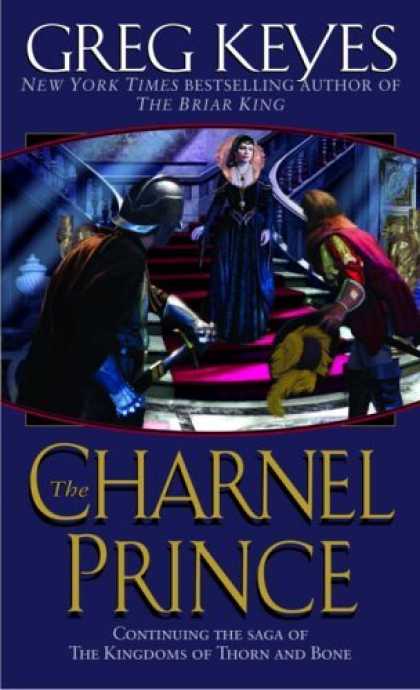
Review: The Charnel Prince by Greg Keyes


The kingdom of Crotheny has been thrown into chaos with the death of King William and other members of the royal family. The Briar King, a figure out of myth, has awoken from eons of slumber causing an epidemic of madness to sweep the countryside turning peaceful villagers into flesh eating monsters. Queen Muriele attempts to maintain order but is stalked by treachery on every side. She sends her protector Neil MeqVren to search for her last surviving daughter Ann. Ann meanwhile, along with Cazio, Astra and z’Acatto is searching for a way to return home and is only just beginning to understand the forces arrayed against her and the role she might play in the future. Meanwhile Aspar, Winn and Stephen have been given a magical artifact by the church and charged with slaying the Briar King. Aspar however has his doubts that the Briar King is truly evil, having had his life saved once before by the mythical figure.

The second book in the series largely follows the same cast of characters from the first book with one notable exception; the composer Leoff. Leoff had been appointed as court composer by King William but arrives when the situation has drastically changed. His character is certainly interesting and I liked the way music is used as a different power for influencing events. Keyes uses this well in setting up the finale of the book which might have gone down the ‘bring all the characters together for a massive confrontation’ route otherwise. The returning characters remain interesting, I especially liked the way Neil and Anne grew up throughout this book as these two seem to have most effected by the events of the first book. There are some intriguing hints that Aspar and Stephen may have been changed on a more physical level that will no doubt be explored in a subsequent book. I just hope Keyes doesn’t take the whole tired ‘organized religion’ is fundamentally evil route and goes with a more interesting concept when the role of the church in these events is revealed.

Overall the Charnel Prince is another strong offering from Keyes 8.25/10.

Saturday, October 16, 2010

Review: The Mirror of Her Dreams by Stephen R. Donaldson


Terisa is a woman with self-worth issues. Growing up as the only daughter of rich but neglectful parents has left her doubting her own existence. As a result she had decorated her apartment with dozens of mirrors to remind herself that she does in fact exist. She has also taken a job as a secretary at a mission house believing she might make a difference. However that notion is soon shattered when she sees that despite how hard the reverend tries he is ineffective. Terisa’s life is turned upside down when a young man named Geraden falls through one of her mirrors. Geraden seems just as surprised about his arrival as he had seen a mighty warrior in the mirror and came across to recruit him as a champion to save his world. Instead he found Terisa. Geraden believes that there are larger forces at work and convinces Terisa to come with him through the mirror. What she finds is a kingdom in danger ruled by a monarch well past his prime and ineffectual. With enemy forces gathering on every side can Terisa make a difference?

What I really enjoyed about this novel is how well it effortlessly combined a number of genres most notably fantasy and mystery. As Terisa was baffled as to what particular character’s motivations were so was I and I love to be kept guessing like that. Donaldson does a particularly excellent job of getting into Terisa’s head and the way her doubts and preconceptions colored everything she encountered was masterful. The magic system of imagery was well thought out and far more interesting than that of the Covenant books. Fans of Sanderson’s enigmatic magic systems will be left speechless. The only negative issue was a slight pacing one, as the beginning was a bit slow but aside from that this was a first-class read.

Overall I’m surprised that the Mirror of Her Dreams does not seem to be held in as high Esteem as the Covenant books. In my humble opinion it’s just as good if not a good deal better. After the cliffhanger ending I’m looking forward to reading the conclusion. 8.75/10

Saturday, October 9, 2010

Essay: Readers are not your bitch

It’s a debate that never seems to go away within the fantasy/sci-fi community; are authors obligated to their readers to have the next book in a series out in a set frame of time? The argument has often focused on George R.R. Martin and the next Song of Ice and Fire book A Dance With Dragons but not exclusively so. For the record here is where I stand in the debate; Of course authors are not obligated to work within such timeframes and should pursue side projects if they are that way inclined. By buying a book the reader has paid for that particular piece of literature and that piece of literature alone. Of course it is only common curtsey for an author to try and keep their readership updated with where things stand.


A recent event has recently made me reexamine the argument from a different angle, namely are readers obligated to the authors? The event in question is Melanie Rawn’s announcement on her website that TOR have cancelled the third book in the Spellbinder series, an urban fantasy/paranormal romance trilogy, due to poor sales but have signed her up to another trilogy closer to the epic fantasy of her earlier days. Rawn’s antics once the news was broken has left me, well quite simply baffled.

Before I get into that I think it is important to provide some background information. This is the second trilogy in a row that Rawn is leaving incomplete, the earlier one being Exiles. The second installment of that series came out in 1997 and ended in a cliffhanger. Melanie underwent some family troubles and a bout of depression that initially left her unable to complete the final volume The Captals Tower. Once Rawn felt herself able to write again she started on Spellbinder. As far as The Captals Tower goes it appears she has done no work on it whatsoever, aside from some possible research a few years ago, and has made no announcement when or if she will ever complete it.


When Melanie made this announcement that Spellbinder was cancelled needless to say that her fan base was not enthused which seems to have come as a surprise to Melanie. She then seems to have had something of a child’s tantrum. With the reaction not being what she expected she took the announcement down. On her website is a thread where her fans can come and rant about the Captals Tower, a place that Rawn has said herself she doesn’t go so fans can go and vent their frustrations without upsetting the author. Yet after the announcement when people were on there voicing their disappoint she turned up with a few catty remarks. On another thread when a reader voiced the opinion that he or she now waits for a series to be completed before buying and reading it Melanie came out and said she doesn’t understand that. Oh come on a reader has been waiting thirteen years so far for a conclusion to Exiles and there is still no end in sight and the author can’t understand that type of behavior? While it is obvious this latest setback is not Melanie’s fault she could have handled it a lot better. With the first two spellbinder books selling poorly there is little chance that another publisher will pickup the third but there is nothing stopping Melanie from self publishing it or posting it on her website. At the time of writing Rawn has made no announcement whatsoever about this book and she shouldn’t be surprised if her fan base doesn’t share the same enthusiasm for the proposed next trilogy. What seems to have set Melanie off is that if her readers take the wait and see approach then her new series will have just as poor sales as Spellbinder did, yet Melanie seems to believe that the readers should buy whatever she writes just because she wrote it. Readers have no such obligation and there is enough of a market out there that they won’t ever have to. Melanie Rawn it times for you to realise your readers are not your bitch.

Tuesday, October 5, 2010

Review: The Adamantine Palace by Stephen Deas


The speaker of the realms, Lord Hyram, is riddled with a strange sickness that is gradually destroying him. He is due to name his replacement and the obvious candidate is Queen Shezira with whom he had an earlier agreement. Prince Jehal however has other ideas. He sets in motion an elaborate scheme to seize power for himself. Against the backdrop of political byplay nobody seems to notice that the loss of a white dragon might have severe consequences. Dragon’s are kept docile through potions mixed by the alchemists, now the white is starting to remember her true nature…and how humans have enslaved her and all her kind.

Dea’s novel sets off at a breakneck pace and the reader is initially left with very little opportunity to actually get to know the protagonists. As the novel wore on I thought that Deas settled into a better rhythm but still everything felt too rushed. Prince Jehal is masterfully realized and really steals the show as the arrogant upstart prince. However aside from one or two of the other POV characters everyone else feels flat and underrealized.

World building is another area that Deas could have fleshed out considerably more. The political system is a medieval type setup with kings and queens controlling their own territory, answerable only to the speaker who is charged with keeping the peace. The political byplay is certainly interesting but several steps removed from a Martin or even a Jordan. The fact that Jehal seemed to carry out every aspect of his plan almost single-handedly felt extremely unrealistic. I don’t think there is a monarch around who has never heard of delegation. The individual cultures that are bound to exist in these kingdoms are never explored and makes the world feel entirely one dimensional.

The premise with the dragons was intriguing and I liked the direction Deas is going with it. Keeping it in the background worked well in creating a sense of impending disaster. In Deas’ favour he is easily injects humor into his banter without having it clash with the darker nature of the story. Although the issue of the speaker is more or less resolved by the end of the book, none of the other plotlines are. I realize that this is just the start of a series but it made the ending anticlimactic.

Overall I don’t feel like Deas is giving us anything really new here. What he does give is good but there are a lot of authors doing it better. The flaws in his writing are certainly not fatal and I expect Deas will come back strongly and realize his obvious potential. 6.25/10.