Sunday, July 26, 2009

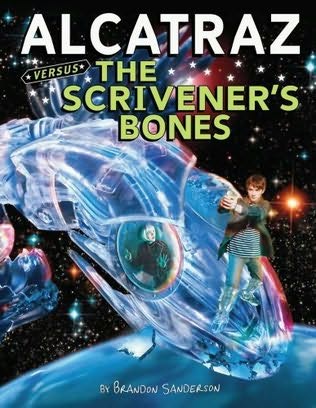
Alcatraz versus the scrivener's bones review


Before picking up the second book in the Alcatraz series I had to wonder if the novelty would wear off. After all the first book was an interesting mix of young adult/fantasy adventure/writing parody that quite frankly had never been seen before. It was both entertaining, fun and a bit silly at times (but in a very good way). Could that formula work a second time? Thankfully I can say the second book is just as good if not better than the first.

After a close encounter with librarian agents in a local airport Alcatraz finds himself in transit to Nalhalla with Bastille, her mother and his newly met cousin and uncle Australia and Kaz in a flying glass dragon. Alcatraz receives a message from his grandfather informing him that he has tracked Alcatraz’s father to the library of Alexandria, which is naturally one of the most dangerous libraries on account of having undead librarians who try to steal people’s souls. Alcatraz and co have to try and find his father and grandfather,keep their souls and avoid a nasty cyborg-like librarian who is a member of the Scriveners Bones and wants to steal Alcatraz’s translator lenses.

The story, like that of the first book, is told by Alcatraz in the style of an autobiography with frequent interruptions for general silliness. Aside from the comments on writing, the genre and literature in general Sanderson introduces some interesting ways to play around with the reader, including using 0’s,1’s and 7’s to make a smiley face in a paragraph.Surprisingly for a YA novel that doesn’t take itself too seriously there is fair amount of character development, especially with Alcatraz and Bastille. Both have grown since the last novel and we really start to see what makes them tick. As can be expected Sanderson really fleshes out one of the magic systems, the smedry talents, in this novel. There is a glimpse of where they came from and how they function. One thing which I really enjoy about this series is the subtle hints Sanderson puts in to future books. It is actually quite fun trying to figure out how some really arbitrary and strange statements will be incorporated into future volumes.

Overall Sanderson is able to successfully recreate the formula that made the first book so enjoyable. If they liked the first one be sure to give the second a go. 8/10.

Friday, July 10, 2009

His Majesty's Dragon


Dragons have been a part of the fantasy genre since its inception. In which case it would not be hard to believe that nothing truly original could be done with them. Naomi Novik dramatically proves that is not the case in her debut His Majesty's Dragon.

The story is set during the Napoleonic wars in an alternate history earth where dragons exist and have been incorporated as something of an air force in the armed forces. William Laurence, the protagonist and captain of a ship in the British navy, is thrust into a difficult position when it turns out there is a dragon egg on a captured French vessel.Normally this would be a godsend but the egg is due to hatch and they are still weeks away from land. To ensure the dragon doesn’t turn feral Laurence unwittingly harnesses him upon his hatching. He is shocked when the dragon turns out to be exceedingly intelligent and speaks to him in perfect English. Laurence names him Temeraire, appropriately after two ships.

The aviators are very different to the rest of society who know very little about dragons. A good chunk of the novel deals with both Laurence and Temeraire’s integration into the aviators. Novik does a particularly good job in creating a genuine 18th century English feel through Laurence’s thoughts and expectations. It is obvious a lot of period research has gone into this and it really shows. I particularly enjoyed Laurence’s reactions to practices within the aviators that defied the days conventions, it always felt genuine.

One criticism that could be leveled is the lack of action. I don’t really feel this was much of issue though, as it is obvious character development and interaction was the crux of this novel. Plus there was a real frantic atmosphere to the action sequences that there were, especially the explosive finale, which could only have been achieved this way. Still it will certainly be interesting to see if Novick changes tact in subsequent novels.

In sum if your looking for something a little bit different with a flagrant atmosphere and strong character development give Her Majesty’s Dragon a try you won’t be disappointed.8.5/10

Monday, July 6, 2009

Alcatraz Versus the Evil Librarians


It’s no secret that I’m a fan of Brandon Sanderson’s writing but I wasn’t quite sure what to expect from his young adult novel Alcatraz Versus the Evil Librarians. After all a good rule of thumb when it comes to movies is to avoid anything with ‘versus' in the title (Yes there are exceptions.) I needn’t have worried I found this book refreshing and overall fun.

The book is presented as an autobiography of Alcatraz Smedly a hero to those in the free Kingdoms, but unknown to us in the hushlands (Thus it is marketed as a work of fantasy.) Alcatraz often addresses the reader directly and has some entertaining opinions on the art of writing, the fantasy genre and literature in general. Alcatraz wants to prove to everyone that he is not a hero nor a particularly nice person. The young Alcatraz is an orphan passed from foster family to foster family because of his uncanny ability to break things. On his thirteenth birthday he receives a bag of sand, supposedly from his real parents as an inheritance. That same day he burns down the kitchen leading his latest foster parents to want to get rid of him. The next day a rather strange old man shows up, claiming to be his grandfather and wanting to see Alcatraz’s inheritance. It is then that Alcatraz discovers the sand has been stolen, the old man informs him by his social caseworker who is actually a librarian in disguise. Incidentally librarians covertly rule the known world through their control of information and subsequent spread of misinformation. And so begins the mission of infiltrating the downtown library with the help of some rather interesting characters.

As always Sanderson has come up with a unique and well thought out magic system, with two actually in this case. The first is a talent that everyone in the Smedly line receives. These are all different for each member and include; breaking things, arriving late, tripping and talking gibberish. All of which prove surprisingly useful. The second is Occulancy which is using specially crafted glasses to do different things, such as setting fires, freezing things etc.

Although obviously aimed at young adults I’d liken it to Shreck with a lot of ideas operating on different levels, ensuring that there is something for everyone. Anyone who liked The Harry Potter or Lost Journal of Ven Polypheme series will love these.I can’t wait to get my hands on the next one. 8/10.

Sunday, July 5, 2009

The Last Wish Review


There is a lot of hype around polish author Adrzej Sapkowski with his win in the inaugural David Gemmell legend award. As a result it was with high expectations that I read the first of his books that has been translated into English;The Last Wish. I was severally disappointed.

Last Wish follows the exploits of a Witcher, Geralt. Witchers are taken as children and are changed and trained to fight monsters. At times Geralt comes across as a fairly interesting character, slightly reminiscent of Harry Dresden but all too often his actions are downright strange and unexplained. The book is divided into a few short stories that follow Geralt’s exploits that are loosely tied together by his time recuperating under the care of his friend the priestess Nenneke after a particularly nasty scuffle with a striga. Presumably most of these episodes are the protagonist’s reminisces by that is certainly not clear. Each of these short stories seems to revolve around fairy tales, including snow white and beauty and the beast with some intense twists. It is difficult to see if there was any point at all to the book. There are some social commentaries applicable to modern society, such as people being more inhuman to other people than the monsters, but they seem pretty basic. Perhaps they would make more sense set against the backdrop of the late 80’s and early 90’s Poland but I don’t know enough about the issue to comment.

My biggest criticism is of the actual writing itself. It is terribly awkward and messy and at times hard to follow. Sentences are often overly long and poorly ordered. I don’t know if this is the Sapkowski’s fault or that of the translator Stok and who knows it might be considerably better in the original Polish. The dialogue of the characters is also overly simplistic and at times makes it hard to relate to them. If I was just handed the book without a cover I would have assumed it was someone’s first go at writing, it really was that bad. Due to the writing I almost gave up fifty pages into the book, I’ve only ever done that twice before in my life. There is also an attempt at humor which comes across as crude most of the time.

As things stand I won’t be giving Blood of Elves a try, David Gemmell award or not. The Last Wish has just put me off of Sapkowski that much. The only way this will change is if someone whose opinion I trust tells me that these flaws aren’t prevalent in the rest of his books. I really hope that most of these are the result of translation, otherwise I really have to question Polish taste in literature. Although I wander if English books come across this badly when translated to other languages. In sum I do not recommended this book.4.5/10.

Wednesday, July 1, 2009

Crossing the Boundary review


Okay so as you might have noticed this isn’t a fantasy book, but I read it and it’s my blog so I can review what I like . For those who might not know Kevin Peiterson is a batsman who plays for the England cricket team. He was born is South Africa but left when he was 20 to play in and qualify to play for England.

Pieterson wrote the book himself and it details his childhood growing up in Pietermaritzberg and Durban, early cricketing career in South Africa, the move to England and his cricketing career in that country. As is to be expected the 2005 Ashes series is the focal part of the book and it begins with it and (almost) ends with it.

For a guy who wouldn’t have had a lot of experience writing Pieterson does a really good job and his writing is concise and to the point. I do however question whether it should have been written when it was, Pieterson was only twenty-six and had only spent about two years playing international cricket. There are parts when it turns it a bit of a bitching session, with everyone from his high school coach to his first county captain coping it. A few more years may have matured and mellowed him and made for a better read. At the end of every chapter there is a piece written by someone who knows Pieterson giving their thoughts on him. The one by Stuart McGill was especially interesting when he says that Pieterson was partly to blame for the problems he had with teammates at Nottinghamshire. It was nice to get a balanced opinion.

Still I did find it fascinating to get an insiders view on what happened during the Ashes. You really get to see the inside working and dynamics of the England team. The version that I read had an extra chapter detailing the disastrous follow up series in Australia. This is all well and good but since Pieterson had already summed up everything in the previous chapter it did feel out of place and just something thrown on at the end at the last minute.

All in all there is a lot of good and bad in this book. I still feel that an autobiography should be written at the end of a career not the start of it and would have gladly waited a few years for a more complete book. 6.25/10

Monday, June 29, 2009

Proven Guilty Review


A few months ago I was lucky enough to win a copy of the audio book Proven Guilty, part of the Dresden files by Jim Butcher. Not only had I not read any of the series before but I had never read any urban fantasy or listened to an audio book since I was a child. So, as you might imagine, this was a different experience for me.

I was thrust right into the action from the get go with the protagonist, Harry Dresden, witnessing the execution of a young man by the White Council. Harry, who has recently joined the Council due to unforeseen circumstances (The Council is in the middle of a war with the Vampire Court which has severally depleted their numbers) and disagrees with what was done. Afterwards one of the council members sets Harry a mysterious mission to be on the lookout for black magic in Chicago. Harry’s day gets even worse as his car is run off the road in a hit and run incident and a call from the daughter of an old friend who requests that Harry bail her out of jail. Turns out she was being sneaky and really wanted to get Harry to bail her ‘boyfriend’ out for an attack at a horror convention. Harry investigates and finds supernatural events are afoot. The pace picks up considerably from there.

Harry Dresden is an interesting character, something of a badass with a heart of gold and we really get to see what makes him tick with the story being told from his (first-person)perspective. Despite not having read any of the previous volumes I had little trouble following the story. Butcher’s weaves in recollections from previous volumes rather well so I had what I needed without feeling bombarded by trivial information. The story is fast-paced and all the seemingly unrelated events are brought together masterfully for the finale.

James Masters, famed for his role of Spike on Buffy the Vampire slayer, is the reader and a damn good one at that. He created believable voices for each of the characters and varied his pace and tone well to suit the mood of different parts of the story. He certainly made my first foray into the world of audio books a memorable one.

In sum I enjoyed Proven Guilty and it has certainly made me want to read the rest of the series (I have already finished the first and second and am halfway into the third.) 8/10.

Thursday, June 25, 2009

Hero of Ages review


Wow. It is very rare for that to be the only word to pop in my head when I read the last page of a book but Brandon Sanderson’s Hero of Ages is something special. It is the concluding part of the Mistborn trilogy. That is something of an understatement, it should be the text book on how to conclude a series. Sanderson’s ability for plotting really stands out. Seemingly insignificant things that happened in the early chapters of the first book turn out to have some rather unexpected consequences. There also a number of plots twists that are really pulled off well.


The story begins a year after the events in the Well of Ascension. Vin and Eland are trying desperately to keep the world from falling apart, but with the mists and ash smothering the world what hope do they have? With the mundane matters of trying to stay alive occupying the rest of the crew, such as trying to secure caches left by the Lord Ruler and dealing with rebellions, it is left to Vin to try and single-handedly stop the abstract force she unwittingly released in the previous book. The story is told from multiple viewpoints including Vin, Eland, Marsh, Sazed and Spook. As before the issues of faith, power and leadership are explored in depth from different characters points of view. Instead of beginning each chapter with extracts from Alendi’s journal as in previous volumes there are extracts from a book composed by Sazed after the events of Hero of Ages. These are quite interesting and give subtle hints of what is to come.


All in all Hero of Ages is a strong conclusion to an interesting series and one I thoroughly Recommend. 9/10.